Wednesday, June 26, 2019

Shades of Grey, by Jasper Fforde

Shades of Grey

Set in the far-future, the world has experienced some sort of cataclysm and the resulting society is dictated by how much color perception one has. Greys (those that can't see color) are the rock-bottom, with the hierarchy following the rainbow after that (Reds just above Greys, Purples at the top). Much of history and technology has been lost, innovation and inquisitiveness are taboo, and a set of inconsistent and often nonsensical rules—spoons cannot be created, lunch is mandatory, counting sheep is forbidden, and the number 73 has been banned—are strictly enforced. Couple this with deadly swan attacks and roaming lightning balls and we have an amazing and madcap environment for an adventure.

Eddie Russet is the hero and narrator, and we follow his journey from a young adult to a leader. Along the way he gets a peek behind the curtain hiding the secrets of power in the land, and has to decide to take his place or revolt. The mystery is solid, although many of the characters are a bit one-dimensional: the brat, the bully, the schemer, etc. The setting is so rich, however, the superficial inhabitants aren't a drawback. Rich with sarcasm and dry humor, this is a rollicking read and difficult to put down.

First Sentence:
It began with my father not wanting to see the Last Rabbit and ended up with my being eaten by a carnivorous plant.

Monday, June 24, 2019

The Last Policeman, by Ben H. Winters

The Last Policeman (The Last Policeman, #1)

In 2011 scientists discover a huge asteroid that is going to hit the earth in about a year, ending life as we know it. As the world unravels with this news (economic panic and massive inflation, a staggering rise in suicide and cultism, people walking away from all responsibility) a young detective discovers what he believes is a murder, but is having a difficult time getting anyone to care. The mystery is a by-the-numbers affair, following one lead to the next, but what sets it apart is the hopelessness and apathy of pretty much everyone but the detective, Hank Palace. The secondary plot involves Palace's sister and a supposed government conspiracy, but that is left largely unresolved and I imagine fodder for future books. A fascinating setting, but I'm not sure I liked it enough to read the next in the series.

First Sentence:
I'm staring at the insurance man and he's staring at me, two cold gray eyes behind old-fashioned tortoiseshell frames, and I'm having this awful and inspiring feeling, like holy moly this is real, and I don't know if I'm ready, I really don't.

Friday, June 21, 2019

Four Hours of Fury, by James Fenelon

Four Hours of Fury: The Untold Story of World War II's Largest Airborne Invasion and the Final Push into Nazi Germany

Operation VARSITY was the largest single-day airborne drop in history, and Four Hours of Fury tells the story. I've read about Pearl Harbor, D-Day, the Battle of the Bulge, and the war in the Pacific, but hadn't ever heard of this operation which was the first push into Nazi Germany, signalling the end of WWII. Fenelon does an amazing job; facts and maps abound, but the focus on the combatants (enlisted and officers on both sides of the battle) keeps the story humanized. He has an amazing knack to toss in a sentence that seems amusing or light-hearted at first, but after more thought is covering the horrors of war. "Instructors reminded them that on an actual jump, if they didn't feel the opening shock of their chute by 4,000, they had the rest of their lives to deploy their reserve." The last sentence is flat-out heart-wrenching, capturing what every wife must have felt when getting a death notice: "There would be no fifth wedding anniversary celebration." Well-written, informative, and hard to put down—not a combination of traits I often ascribe to a history book, but they apply to Four Hours of Fury in spades.

First Sentence:
Three months before they dropped into Germany, the troopers of the 17th Airborne entered combat for the first time in a manner entirely different from how they'd been trained.

Sunday, June 02, 2019

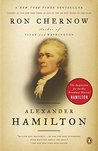
Alexander Hamilton by Ron Chernow

Alexander Hamilton

With the musical Hamilton making it to Austin this year I decided to read the book that inspired it before attending. A hefty tome—731 pages of narrative alone—but I managed to finish the day of the show. Very glad I did this; several friends said the show was hard to follow in places (especially around the actor playing Lafayette and Jefferson; his accent was thick and made him hard to understand even having heard the music before) but I was continually rewarded with recognition of where the songs matched the book. I found the musical to be excellent, and the book as well.

Other than Hamilton being the main author of The Federalist Papers, his visage being on the $10 bill, and his death as a result of a duel with the sitting Vice President at the time, my knowledge of the Founding Father was light on details. It is amazing to see how what he accomplished in only six years as the Secretary of the Treasury still affects us today. He fought for a strong central government and standing military led by the executive branch and for closer ties to Britian. He founded the US Mint, the first national bank, the Coast Guard, and the New York Post. His strong difference of opinion with Thomas Jefferson (who believed in strong state governments and a largely agrarian society) effectively created the political party system that still dominates politics now. Finally, Hamilton also was the first major American politican involved in a sex scandal, which in all likelihood prevented him from becoming President.

One quote that stuck with me: "[Hamilton] viewed 'hypocrisy and treachery' as 'the most successful commodities in the political market. It seems to the be the destined lot of nations to mistake their foes for their friends, their flatterers for their faithful servants." In our current era of amoral politicians, fake news, and idiological echo chambers this still rings true 226 years later. Hamilton was truly an impressive individual.

First Sentence:
Alexander Hamilton claimed Nevis in the British West Indies as his birthplace, although no surviving records substantiate this.

Monday, May 27, 2019

How to Live Safely in a Science Fictional Universe, by Charles Yu

How to Live Safely in a Science Fictional Universe

This is an exceedingly strange novel. The main character (and author) is Charles Yu; he lives in a small time machine with his non-existent dog and a depressed AI. After accidentally encountering and shooting a future version of himself, he takes a book from his dying future self named How to Live Safely in a Science Fictional Universe (by Charles Yu) and then tries to change his future by rewriting the book. There is a fair amount of philosophy and introspection throughout, with Yu trying to come to grips with his relationship with his father, the way you see someone as a child and then later as an adult. Much of the writing is stilted and complicated, often taking a second pass to properly parse. "conjectures, currently unproven but believes to be true ... That chronodiegetics is a theory of the past tense, a theory of regret. That it is fundamentally a theory of limitations." Coupled with an unsatisfying conclusion, I was quite disappointed in a book that has generally been well-reviewed and I expected to really like.

First Sentence:
There is just enough space here for one person to live indefinitely, or at least that's what the operation manual says.

Sunday, April 14, 2019

The Arena, by Rafi Kohan

The Arena: Inside the Tailgating, Ticket-Scalping, Mascot-Racing, Dubiously Funded, and Possibly Haunted Monuments of American Sport, by Rafi Kohan

I really wanted to like this book, and I'm not entirely sure I didn't. Watching sports is a big part of my life: we have had season tickets for Longhorn football since 1992 and it has been longer than that since I've missed a home game1. When I travel, seeing a local event is one of my favorite pastimes, especially in a stadium I've not seen previously. So when I was gifted The Arena I was pretty excited, especially with a subtitle like Inside the Tailgating, Ticket-Scalping, Mascot-Racing, Dubiously Funded, and Possibly Haunted Monuments of American Sport. Sadly, there is more content about the people that inhabit these arenas than the arenas themselves.

It starts strong with a chapter that reads like a love-letter to some of the greatest old-school stadiums in America: the frozen tundra of Lambeau Field; Fenway Park, home of the Green Monster; and, the friendly confines of Wrigley Field. Later there is a chapter dedicated to the groundskeepers (whose work is seemingly only noteworthy when it is terrible), and later still a wonderful picture of the logistical nightmares of running these behemoths. All great stuff, and I wish there was more of it.

There is an entire chapter about the Superdome in New Orleans, but most of the detail is around the role the building played during the aftermath of Hurricane Katrina—and much of the Katrina rhetoric fell into the same quagmire as most other writing about the disaster, giving the impression that Katrina affected New Orleans and no other part of the country. Most disappointing was the chapter on college stadiums; all that is covered is the Penn State sexual abuse cover-up and Joe Paterno's legacy. So many collegiate cathedrals out there—the Rose Bowl, the Big House in Ann Arbor (there was a picture of this but no real discussion), Death Valley at LSU, hell, even Kyle Field—but instead all we get are the details of a vulgar scandal.

I'd recommend this unhesitatingly to any casual sports fan. The stories following the people in and around the buildings (scalpers, half-time entertainment, and unruly and misbehaving fans) are compelling and made the book hard to put down. I was hoping for more stories about the buildings themselves though, and ultimately left unsatisfied. A very good book, but a misleading title gave me a misleading impression.

First Sentence:
By the time I meet the mayor of Lambeau Field, he's already had a few.

1My mother went to hear the author speak in Dallas, and they gave away a door prize to the person that had been in the most professional, semi-pro, or collegiate stadiums; I believe the winner was in the low 50s. This idea fascinated me, so I went through my history and tried to record all the places I've seen some sort of organized sport. Turns out it is quite a few, but I have multiple friends that leave me in the dust here. I look forward to expanding this list over the coming years!

Tuesday, April 02, 2019

Legacies, by L. E. Modesitt, Jr.

Legacies, by L. E. Modesitt, Jr.

Modesitt is a prolific author, and I've read literally dozens of his novels—and enjoyed them all. Legacies is the first (of eight so far) of yet another series, and it follows the same basic pattern as most of his work: young man discovers he has a once-in-a-lifetime magical talent, teaches himself how to use said talent while keeping it hidden from everyone, learns to be an exceptional soldier and leader, and single-handedly disposes of a horrible oppressor that was threatening the world at large. That said, the pattern is still quite entertaining and compelling enough I read this nearly 600 page book in a single day. One thing I don't remember in other Modesitt novels is how the music is so recognizable; in several places people sing and the lyrics are clearly all based on popular tunes such as "Don't Sit Under the Apple Tree" and "Seven Drunken Nights". When reading "Saddled, and booted, / and bridled rode they..." it was easy to picture the mournful tune and the loneliness of the vocalist. This extra dimension allowed the songs to be performed rather than just read, bring that much more impact to these scenes.

While the villain is obvious, the effects of her villainy are not as blatantly evil as in most fantasy tropes. The Matrial has enslaved all men (and uncooperative women) in her lands with a magical collar; free will still exists, but the all-female ruling class can punish or kill anyone with a collar that has been accused of a crime. The overseers can also tell when someone is lying, so theoretically justice is harsh but fair. As a result, the land is largely peaceful (but aggressive towards its neighbors) and both scarcity and abuse have largely been eliminated. However, men aren't given a choice about wearing collars (the situation of children isn't addressed; unclear when a boy is equipped) and POWs are all forcibly fitted and made to serve in the army. The ruling women aren't all bastions of honor either; in one scene two accused criminals are put to death, when it was clear to the judge and executioner that one was innocent. After living in this world (with a collar) for a year or so, our hero is conflicted, wondering if the end justifies the means as this land is seemingly much more equitable than his homeland, where poverty and vice is common, and the rich have unbalanced power over the poor. Urban and rural, rich and poor, male and female, freedom and slavery, right and wrong—all these dualities are examined and the results are thoughtfully not always black and white.

First Sentence:
In the quiet of the early twilight of a late summer day, a woman sat in a rocking chair under the eaves of the porch, facing east, rocking gently.

Search This Blog