Showing posts with label bookclub:marblemidnight. Show all posts

Tuesday, May 12, 2020

Tarzan of the Apes: The First Three Novels, by Edgar Rice Burroughs

Tarzan of the Apes: The First Three Novels (Tarzan, #1-3)

Any character that remains popular for over a century has something unique to offer. Tarzan could easily be called the first superhero: he possesses extraordinary strength, stamina, speed, agility, healing, and intelligence—basically Captain America without needing the Super Soldier Serum. Tarzan can speak with apes, kill gorillas, lions, and crocodiles with his bare hands, and his senses of hearing and smell rival those of bats and bears. His skill handling animals is also remarkable; at one point Tarzan trains a group of apes to man oars and sail through the Atlantic Ocean. There isn't much depth to these books (the volume I read collects the first three of twenty-four) but they are thoroughly entertaining pulp novels.

Both set and written in the early twentieth century, the style of writing suffers from what we expect today. Plots are melodramatic and driven by coincidence after coincidence, the characters are thin and one-dimensional, and the rampant negative stereotyping exposes the widespread sexism and racism common in the period. Despite all this, there is an undeniable charm to these stories and it is easy to see why they remain in favor today. Escapist and fun, the Tarzan books are a wonderful set of adventures.

First Sentence from Tarzan of the Apes:
I had this story from one who had no business to tell it to me, or to any other.
First Sentence from The Return of Tarzan:
"Magnifique!" ejaculated the Countess de Coude, beneath her breath.
First Sentence from The Beasts of Tarzan:
"The entire affair is shrouded in mystery," said D'Arnot.

Thursday, March 05, 2020

Bonk, by Mary Roach

Bonk: The Curious Coupling of Science and Sex

If you are shy or uncomfortable with the topic of sex, then this is not the book for you. The title of the introduction is "Foreplay" and it ramps up from there. Bonk is subtitled The Curious Coupling of Science and Sex and this is not an exaggeration. From scientific examinations of the penis, testicles, and clitoris to coital imaging to sex toys to genital transplants and implants, this book has it all. Oh, and it is funny as hell, too!

Roach has an amazing writing style that allows the reader to delve deeply into the mechanics, psychology, and science of intercourse while maintaining a laugh-out-loud approach to the topic at hand. For instance, by taking MRIs of people in flagrante delicto scientists learned that after penetration the penis has the shape of a boomerang. Roach helpfully adds, "But not the precise dynamics. If you hurl an uprooted penis into the air, it will not come back to you. It will most likely, and who can blame it, want nothing to do with you." We also learn that sex hormones "make individuals perceive other individuals as more attractive than they'd normally perceive them. Hormones are nature's three bottles of beer." Even the footnotes are hilarious: "Nasal congestion is an erection inside your nose." "Who clubs a hamster? What would you even use to deliver “a blow” to a head that small?" "The Anal Pad should not be confused with a prior invention called the Anal Napkin, which, in turn, should not be confused with the dinner napkin." "Nominations for a Nobel Prize ... remain secret for fifty years. You make the claim, and nobody can prove otherwise until after you're dead. Add one to your résumé today!"

I enjoyed her earlier book Stiff (about cadavers, not erections) and this one was just as entertaining. If you are interested in how scientific research about sex is conducted or the physiology of the reproductive system (or simply want to laugh a lot), Bonk is a good choice. If, however, you are less interested learning in what an orgasm scientifically is and would rather learn how to cause an orgasm, maybe check out Ian Kerner's She Comes First.

First Sentence:
Albert R. Shadle was the world's foremost expert on the sexuality of small woodland creatures.

Wednesday, June 01, 2016

The B Side, by Ben Yagoda

The B Side: The Death of Tim Pan Alley and the Rebirth of the Great American Song, by Ben Yagoda

My mother loves the theater and my father loved movies, so I grew up with the sounds of Broadway and Hollywood in the house. I'm as familiar with the music of Cole Porter, George M. Cohan, Irving Berlin, George Gershwin, and Duke Ellington as I am Kris Kristofferson, Bruce Springsteen, Paul Simon, Mick Jagger and Keith Richards. The B Side traces American song craft in the early 20th century, including the rise of ASCAP and BMI, the payola scandal, and the shift in prestige from writers to performers. It is sometimes difficult to read a book about music; words are for the eyes, but melody is for the ears (and both nurture the soul). This story often contains long lists of titles, such as "Que Sera, Sera (Whatever Will Be, Will Be)," "I Got Rhythm," "Always," "Stormy Weather," "They Can't Take That Away from Me," "You're the Top," "Sophisticated Lady," "Swinging on a Star," and "It Don't Mean a Thing (If It Ain't Got That Swing)." I find it virtually impossible to see these names and not pause to hear the tune in my head, making this a very long read, albeit an enjoyable one.

One critique is that the author clearly has a distain for rock-and-roll that often seems arrogant. In places this comes across as broad overstatements such as "the pop music of every era offended and mystified the older generation;" while more true than not, I'm certainly an exception as are many of my friends. In other places, the sentiment is imperiously haughty: "But it isn't possible for [songwriters such as Willie Nelson, Brian Wilson, Smokey Robinson, or Paul McCartney] to write a standard—or, as Keith Jarrett found out, it is possible, but really hard." I believe "Yesterday" and "The Tracks of My Tears" are every bit as good as "Night and Day" or "Puttin' on the Ritz." Yagoda's point is that in his opinion rock is less musically and lyrically sophisticated than a standard, but he seems to have deliberately forgotten that beauty is in the eye of the beholder—or in this case, the ear...

First Sentence:
While not quite on the level of a Richard Rodgers, a Cole Porter or an Irving Berlin, Arthur Schwartz was certainly in the top echelon of American songwriters.

Tuesday, May 03, 2016

Mr. Hornaday's War, by Stefan Bechtel

Mr. Hornaday's War: How a Peculiar Victorian Zookeeper Waged a Lonely Crusade for Wildlife That Changed the World, by Stefan Bechtel

I had no idea who William Hornaday was before reading this book. Turns out not only did he found the National Zoo and run the Bronx Zoo, but he was basically the father of the modern conservation movement as well. Hornaday spent his early life traveling the world collecting (and hunting) animal specimens while becoming one of the leading taxidermists in the country. Taxidermy led him to realize that the American Bison had been virtually made extinct; this realization is what pushed him into the forefront of wildlife conservation. His tenacity in the face of hunters, the gun and feather lobbies, and the general apathy of the public led to the first strong national laws protecting animals being passed, and preventing the extinction of the bison and the fur seal.

The author is clearly sympathetic to the cause of wildlife preservation; the tone is one of condemnation towards those not firmly in favor of the conservation movement. He uses terms like "waking up" to describe joining the movement, and calls those not involved the enemy. Hornaday clearly held these opinions, but the same phrases and attitude pervade the narrative even when not quoting Hornaday directly. The biased writing didn't harm the story or make things any less interesting, but I did find it a bit jarring at times. Still, overall this was a well-researched biography about a very interesting man.

First Sentence:
On the fair spring morning of May 6, 1886, an intense-looking young gentleman with eyes that burned like meteors and a jet-black beard vaulted up the stairs of a Pennsylvania Railroad westbound train, which was steaming at the platform in Union Station, near downtown Washington, D.C.

Tuesday, March 22, 2016

what if? by Randall Munroe

what if? Serious Scientific Answers to Absurd Hypothetical Questions, by Randall Munroe

Randall Munroe is the author of one of my favorite web comics, xkcd, and so I was excited when what if? was chosen for our book club. And for good reason: this is the funniest book I've read in ages. I read it while traveling recently and my wife kept looking at me oddly when I'd literally laugh out loud! The concept here is that Munroe gives "serious scientific answers to absurd hypothetical questions," heavily laced with his trademark humor and cartoons. "Absurd" is certainly an appropriate word, with the book including questions such as "From what height would you need to drop a steak for it to be cooked when it hit the ground?" "How fast can you hit a speed bump while driving and live?" and "What would happen if you were to gather a mole (unit of measurement) of moles (the small furry critter) in one place?" The author then examines the questions with a scientific bent, albeit often ridiculous as immortal people and bullets with the density of a neutron star are theoretical at best.

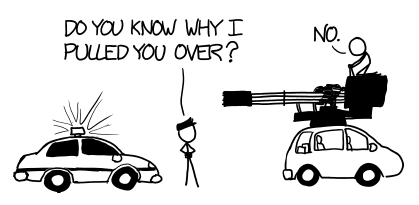
It is hard to pick my favorite vignette; they were all fantastic. "Periodic Wall of the Elements" discusses the possibility of building a periodic table where each block is actually made of the respective element. "The sixth row would explode violently, destroying the building in a cloud of radioactive, poisonous fire and dust. Do not build the seventh row." Actually, what I'm confused about is how. "Relativistic Baseball" examines a baseball being pitched at 90% of the speed of light, ending with "everything within roughly a mile of the park would be leveled, and a firestorm would engulf the surrounding city. Major League Baseball Rule 6.08(b) suggests that in this situation, the batter would be considered “hit by pitch” and would be eligible to advance to first base." And "Machine-Gun Jetpack" has possibly my favorite cartoon (included here) with the caption "Actually, what I'm confused about is how."

On top of the humor inherent in the questions and answer themselves, there is a constant stream of comedy throughout the narrative as well. Pop-culture references abound, with Gremlins, Furbies, Star Wars, Lord of the Rings, Dragon Ball Z, and Firefly making common appearances. At one point Munroe gets int an argument with himself in the footnotes about the proper capitalization and attribution of "Lego." And one of my favorite running gags was the use of [citation needed] for patently obvious items: "After all, the Empire State Building sits on a base like that, and it's more than a few days old[citation needed] and hasn't disappeared into the ground.[citation needed]" Even the book jacket was funny, with the flip-side showing a map of "the world after a portal to Mars opened at the bottom of the Marianas Trench, draining most of the oceans."

I can't say enough good things about this book. Funny and educational; everyone in my book club liked it, as did both of my sons. Munroe gathers these questions from his website, so hopefully a sequel is in the cards!

First Sentence:
Q. What would happen if the Earth ad all terrestrial objects suddenly stopped spinning, but the atmosphere retained its velocity?

Tuesday, March 01, 2016

Hell and Good Company, by Richard Rhodes

Hell and Good Company: The Spanish Civil War and the World It Made, by Richard Rhodes

Before reading Hell and Good Company pretty much all I could have told you about the Spanish Civil War was that it occurred between World Wars I and II and Hemingway wrote For Whom the Bell Tolls based on his experiences there. Rhodes only lightly touches the military and political aspects of the war, instead concentrating on the innovations that were made real during this time. I was shocked to discover that frontline blood donations weren't commonplace before Spain, and the practice of sealing open wounds and compound fractures with plaster to keep them clean and immobile finally gained medical acceptance at this time, too. Hard to believe that before the late 1930's a broken leg was usually amputated on the battlefield in order to save the soldier. Military tactics also saw a lot of advancement during this time; air power truly came into its own, resulting sadly in prominent, purposeful civilian targets and the first war with a city bombed into literal rubble.

Rhodes has a sophisticated writing style; readable, but with an impressive (and occasionally off-putting) vocabulary: "In pursuing a latter-day, reverse reconquista he was less a fascist than an aggrandized martinet." One chapter in particular I found difficult to finish; the author discusses the creation of Picasso's Guernica, explaining in excruciating detail how the painting changed with each small step in the artistic process. Oddly, there isn't a rendering of the entire finished work included, so much of the included minutia was severely lacking in context. This literary wandering was an anomaly, though, and the book itself was both engrossing and appealing, and I recommend it to anyone interested in this time in history.

First Sentence:
Barcelona, 25 July 1936: In the glare of Spanish summer, the first witnesses to the igniting civil war are leaving to tell the world.

Monday, February 01, 2016

Coreyography, by Corey Feldman

Coreyography: A Memoir, by Corey Feldman

All I really knew about Corey Feldman before reading his memoir was I liked several of his early movies —Gremlins, The Goonies, Stand By Me, and my favorite, The Lost Boys — and like many child stars, he fell into a well-publicized spiral of drug abuse and unfounded arrogance. After reading Coreyography, though, Feldman comes across as a somewhat tragic figure. Yes, drug abuse is self-inflicted and not usually worthy of much empathy, but abusive parents and sexual molestation make the descent into addiction somewhat understandable, an escape from what must have been a horrible reality. His father was largely absent in Feldman's earliest days, leaving him in the care of his untreated schizophrenic mother and a family that looked at him like a paycheck rather than a person. Later, when his father returned to run his career, an assistant hired by his dad began molesting Feldman, starting a cycle of exploitation that lasted for years and included a couple of half-hearted suicide attempts. When Corey turned 15 he legally emancipated himself from his family, but he had already been introduced to cocaine and sadly found himself with his only adult role model being his friend Michael Jackson. Jackson was still a few years out from his own downfall, but still a long way from what I'd call a positive influence. Two failed marriages and a couple of stints in rehab later, Feldman appears to have gotten his life together and the book ends on a hopeful note, Feldman bonding with his son. This is a surprisingly personal and revealing memoir; I'd expected braggadocio and rationalizations, but instead got an honest look back over an amazingly unhappy life.

First Sentence:
I am three years old, sitting at the small round breakfast table in our tiny kitchen, eyeing a half-open box of cereal.

Thursday, January 07, 2016

The People's Republic of Amnesia, by Louisa Lim

The People's Republic of Amnesia: Tiananmen Revisited, by Louisa Lim

My first trip to Beijing was in the summer of 1988. China immediately captured my attention; I encountered a world unlike anything I'd seen, beautiful and oppressive at the same time. Almost exactly one year later, the Tiananmen Square Massacre took place and captured the attention of the world. Now, nearly thirty years later, Louisa Lim takes a look at the fading legacy of the rebellion.

For me, this was an unforgettable moment in time, in league with the Space Shuttle Challenger explosion or 9/11. The image of an ordinary man standing in front of a column of tanks is as powerful a picture as I've ever seen, and recognized virtually everywhere as the iconic moment of the event. In China, however, only 15% of university students in Beijing recognized it, due to the government systematically blocking and censoring any information related to the event. This sad fact is from where Lim draws her title: The People's Republic of Amnesia.

The author does a great job of interviewing many people about the incident, from mothers of survivors to soldiers that were there, from students at the time to students of today. These varied viewpoints give an in-depth look at both the event then and how it is remembered now—or not remembered as the case may be. In particular, the chapter on Chengdu and the oppressive events that took place there in the same timeframe was eye-opening. It would have been a truly captivating read if I could have shook the feeling that Lim continually patted herself on the back, congratulating herself on writing such a significant book. She may be correct in its momentousness, but the self-aggrandizing tone was irritating to no end. This is an important book, and gives a view into not only Tiananmen, but into the current Chinese government as well. The tone is annoying, but well worth forcing yourself to finish.

First Sentence:
Plumes of smoke from fires frame the Gate of Heavenly Peace, as soldiers pile the students' possessions to burn them.

Sunday, April 26, 2015

Tough Sh*t, by Kevin Smith

Tough Sh*t: Life Advice from a Fat, Lazy Slob Who Did Good, by Kevin Smith

I like Kevin Smith's work; from Clerks to Green Arrow to Daredevil I find him both clever and funny. There are several autobiographical stories in Tough Sh*t—many of which are covered in more detail elsewhere—such as Smith's feud with Bruce Willis and the arrogance of Southwest Airlines. In and around the vignettes Smith weaves in advice for how to approach life. The guidance is often odd, such as where he compares the odds of a single sperm fertilizing an egg and creating a human being to self-actualization: "Remind them they've already beaten the odds, so the existence that follows is merely a victory lap to do with as they please." A phrase I found less specious and much more thoughtful occurs a little later in the chapter: "In the face of such hopelessness as our eventual, unavoidable death, there is little sense in not at least trying to accomplish all your wildest dreams in life." Smith's trademark humor and irreverence come through loud and clear throughout this short but entertaining read.

First Sentence:
I am a product of Don Smith's balls.

Tuesday, March 24, 2015

See How Small, by Scott Blackwood

See How Small, by Scott Blackwood

This novel is loosely based on the 1991 Yogurt Shop Murders here in Austin. It is very difficult to read, raw and emotional throughout. The rape and murder of three teenagers is graphically described, and truly horrifying. Each chapter is told from the point of view from different people affected by the crime, including the family of the victims, the driver of the getaway car, the addled homeless witness, the firefighter that discovered the bodies, and the ghosts of the girls themselves. Nobody has a happy ending, and there isn't a firm conclusion—paralleling fact the actual murders have remained unsolved. The prose is haunting and powerful, but depressing and uncomfortable at the same time. Not what I'd call a beach read, but well worth your time.

First Sentence:
We have always lived here, though we pretend we've just arrived.

Tuesday, January 27, 2015

Kelly, by Clarence L. "Kelly" Johnson with Maggie Smith

Kelly: More than My Share of It All, by Clarence L.

Clarence "Kelly" Johnson was one of the key aircraft designers at Lockheed, involved with such successes as the P-38 Lightning, the U-2, and my favorite, the SR-71 Blackbird. Kelly is the autobiography of this engineer, and a great deal of history about the Lockheed Corporation, now Lockheed Martin. The look Kelly gives into how aircraft were developed in the early part of the aviation era is fascinating, with wind tunnels and advanced metallurgy in their infancy. The mortality rate for test pilots was high, and at times Kelly came across as quite cold discussing this. "...the plane exploded on impact. The design result was an improved spline and pump and installation of an emergency fuel system."

The famous Skunk Works program was also founded by Kelly. The software industry has co-opted the term: at a good company it is used to describe small teams that foster innovation, and at a bad one it is used to ask people to do extra work under the guise of innovation. (Sadly, the latter is more common.) It was interesting reading about the formation and goals behind the original; one quote that stuck with me is one I'll use in my own career: "it is much better to lead people, not to drive them." That is a very eloquent way of phrasing a difficult concept—which probably is why it still resonates today despite being originally said in the 1930's.

Kelly wrote the book in 1985 and died in 1990. The conclusion was exactly what you'd expect from an engineer that was born when heavier-than-air craft were looked at with skepticism and retired after man walked on the moon. "By the year 2000, the 'death rays' of the comic strips and and science fiction will be a reality." The Star Wars SDI program never did materialize, but the LaWS laser system is about to be put into active service. Still a long way from phasers or blasters, but then we don't have our flying cars yet either. Ending aside, this book is a great look at a glamorous time in aviation history, and a peek into the life of a very interesting man.

First Sentence:
Northern Michigan in mid-winter is harsh, cold country to a young immigrant seeking to carve out a new life.

Saturday, January 25, 2014

George Washington's Secret Six, by Brian Kilmeade and Don Yaeger

George Washington's Secret Six: The Spy Ring That Saved the American Revolution, by Brian Kilmeade and Don Yaeger

This is a pretty interesting book about the Culper Spy Ring which was active in New York during the American Revolution. I didn't know much about the ring other than through pop culture references in Y: The Last Man and White Collar and quite enjoyed learning more about it, and the major impact on the war the spies brought about. The biggest (but not only) coup the ring accomplished was providing key intelligence that eventually prevented Benedict Arnold from turning West Point over to the British. Truly fascinating.

This is an easy read, with short chapters and just over 200 pages written at maybe a middle-school level. There is a lot of dialog here, capturing conversations between characters that couldn't possibly be known today, making this an odd blend of fiction and non-fiction. Overall this certainly gets a thumbs up as a basic introduction to the Culper Ring, and a good set of references in the back for digging in further.

First Sentence:
The execution of Nathan Hale on September 22, 1776, was the lowest point in a month of low points for General George Washington.

Monday, December 02, 2013

Beer School, by Steve Hindy & Tom Potter

Beer School, by Steve Hindy & Tom Potter

The two founders of the Brooklyn Brewery wrote Beer School so I was expecting a straightforward corporate history describing how a couple of home brewers hit it big. Instead, I found a thoughtful look at entrepreneurship and business partnerships.

The chapters are written by one of the two founders, with the other weighing in at the conclusion often with a different point of view. Neither of these guys had ever started a business before; one was a foreign correspondent for the AP and the other was a middle-tier banker. They cover how they decided to go into partnership, writing their business plan, collecting funding, publicity, managing a staff and performance reviews, and deciding when to cash out among other things. It is an honest portrayal, covering mistakes as well as successes, and refreshingly the pair doesn't always agree.

The writing is uneven, with the styles of Hindy and Potter being quite different. Hindy is the better author (not surprising as he was a reporter); Potter's chapter on raising money was especially repetitive: "venture funding" is defined three times in four pages. Potter also has some odd ideas about management. "People who read lots of resumes, just like people who read lots of resumes, aren't looking for a creative format. They want something familiar and comprehensible." As someone that has been a people manager for over a decade I can't disagree more. I love when I see an original CV; even if it is terrible I appreciate that someone tried something different and the break from monotony it brings. When Potter discusses writing a business plan and mission statement, though, he comes off much more polished. Clearly when the topics skew closer to his comfort zone his writing improves.

The insights into starting a business were enlightening, and being set against the rise of the craft brewing industry in America over the past 25 years made this a surprisingly difficult book to put down. Much like beer itself!

First Sentence:
My head was thumping and I was drenched in sweat when I was jolted awake on a fresh sunny morning in May 1984 by the blasts of two mortar shells in the parking lot outside my second-floor room at the Alexander Hotel in East Beirut.

Wednesday, October 30, 2013

One Lump or Two?, by Darren Couchman

One Lump or Two?: A Humourous Story of One Man's Fight Against Testicular Cancer, by Darren Couchman

Carcinomas are no laughing matter, but Couchman tells his story of battling testicular cancer with a lot of whimsy and warmth. Diagnosed at 27 years old and within a decade of losing both his parents to the disease, he had every right to succumb to despair but instead approaches his diagnosis head on using humor (much of it self-deprecating) as his main weapon. "[Doctors] are professionals and are more concerned about helping you, rather than laughing at your privates. Anyway, that's your partner's job." Couchman is not a professional writer and it often shows—the style is pedestrian leaves a lot to be desired—but his message comes through loud and clear: fighting a serious disease is an incredibly tough campaign, and a positive outlook and the support of friends and family are essential to a successful outcome. As far as patients go Couchman was lucky; one major operation and a limited chemo routine resulted in victory. I still wouldn't call his experience easy, though, and certainly don't want to go through any of that myself. If I am personally faced with such a situation, though, I hope I can approach it with the same forthright manner and joie de vivre.

First Sentence:
It's the year 2000.

Tuesday, October 01, 2013

The Psychopath Test, by Jon Ronson

The Psychopath Test: A Journey Through the Madness Industry, by Jon Ronson

I don't have much use for psychology or psychiatry. These are the branches of science used by those that seemingly justify such nonsense as curing homosexuality. Psychology experiments often seem to be ethically murky and confirm their initial hypotheses at an unbelievably high rate. On the other hand, I'm not someone that believes mental illness isn't a real disease, either. Like most things, there are good and bad aspects to psychology and clearly it has helped thousands of people live happier lives. So, when my book club chose The Psychopath Test as the monthly selection I was intrigued and looking forward to a closer examination of the industry.

I found this look into psychology and psychopaths in particular fascinating. Ronson examines all sides of the situation, talking with editors of the bible of mental disorders (the DSM-IV-TR), extreme 9/11 Truther and self-proclaimed messiah David Shayler, the author of the most common tool for diagnosing psychopathy (the PCL-R), and a powerful group Scientologists that are trying to stamp out psychology entirely (the CCHR). Written in first person Ronson seems greatly influenced by whichever group he speaks with last, see-sawing between radically different points of view. He doesn't really make any conclusions, but simply walks through the various beliefs and allows the reader to decide on his own. Most compelling to me was the debate about where the line between mentally ill and simply eccentric is drawn; what I learned here makes me a bit scared as to how fast we jump to diagnosing illness and prescribing drugs for behaviors such as hyperactivity and short tempers—especially in children.

The most surprising aspect of the book is the revelation that not all psychopaths are criminal; in fact, they are everywhere and often lead normal lives. A desire to win and a love of power are common sociopathic traits, as is a lack of normal human feelings. "They're the boss or coworker who likes to make other people up just for the pleasure of seeing them jump. They're the spouse who marries to look socially normal but inside the marriage shows no love after the initial charm wears off." Even more disturbing than the psychopath next door is the realization that these behaviors result in a preponderance of such people in leadership positions. "The higher you go up the [corporate or political] ladder, the greater the number of sociopaths you'll find there." From now on I'll be equating politicians with psychopaths, which frankly explains a lot about our government.

First Sentence:
This is a story about madness.

Thursday, August 08, 2013

The Secret Agent, by Joseph Conrad

The Secret Agent, by Joseph Conrad

For a book considered to be one of the first and greatest espionage thrillers, it was murder getting to the end. The writing is stilted and overblown, and I often had to reread passages to make sense of them. "Mrs. Neale was the charwoman of Brett Street. Victim of her marriage with a debaucher joiner, she was oppressed by the needs of many infant children. Red-armed, and aproned in coarse sacking up to the arm-pits, she exhaled the anguish of the poor in a breath of soap-suds and rum, in the uproar of scrubbing, in the clatter of tin pails." Not an easy read.

The plot follows a somewhat incompetent agent provocateur that is playing both sides—talking to the police and working for an anarchist cell. He is forced into an act of insurrection that goes awry and tragedy strikes. I suspect that there are some insightful conclusions that can be drawn with modern terrorism and national security, but frankly I had such a difficult time getting through the superficial story that I was uninterested in looking any deeper. Disappointing.

First Sentence:
Mr. Verloc, going out in the morning, left his shop nominally in charge of his brother-in-law.

Thursday, July 11, 2013

The Friends of Eddie Coyle, by George V. Higgins

The Friends of Eddie Coyle: A Novel, by George V. Higgins

Reluctantly, I'd have to say I enjoyed reading this novel. With not a single likable character and no identifiable heroes or villains the first third is interminably slow as the reader has to wait for the various plot lines to be firmly established and intermingle before it becomes interesting. There is very little descriptive text; nearly the entire story is told with dialogue—it often felt more like a play than a novel other than the widely varying locations. The speech comes across as very authentic rather than something you'd hear watching Law and Order but one mild complaint I had is that many of the voices sound the same: one thug speaks in much the same tone as the next. There isn't really a mystery here, just a story of a handful of crooks and cops going about their business. As far as Boston crime novels go I think I still prefer Parker to Higgins, but if you don't need a sympathetic lead to enjoy a book you could do a lot worse than The Friends of Eddie Coyle.

First Sentence:
Jackie Brown at twenty-six, with no expression on his face, said that he could get some guns.

Wednesday, June 05, 2013

The Yellow Birds, by Kevin Powers

The Yellow Birds, by Kevin Powers

This is the story of two soldiers, both of whom went to war but neither entirely came back. Powers writes a powerful tale that does a marvelous job of describing both what a soldier's life serving during the war in Iraq is like, and what it is like after returning home. The imagery is powerful and poetic, painting pictures that vividly mirror the bleak outlook of war. "We'd been granted a reprieve from the heat and the dust, both gently smothered by flat sheets of rain fallen from skies the color of unworked iron." Powers also captures the internal melancholy of PTSD, giving a potent glimpse into what some returning soldiers endure. "I was tired of my mind running all night through the things I remembered, then through things I did not remember but for which I blamed myself on account of the sheer vividness of scenes that looped on the red-green linings of my closed eyelids." While beautifully written, the subject matter makes this difficult to finish. A depressing book, but one well worth reading.

First Sentence:
The war tried to kill us in the spring.

Thursday, April 25, 2013

The Last Best League, by Jim Collins

The Last Best League: One Summer, One Season, One Dream, by Jim Collins

While I like baseball, I admit I'd never heard of the Cape Cod Baseball League before reading this book. I found it fascinating: a detailed look at what is often the last phase of amateur baseball prior to a professional career. The juxtaposition of an amateur league run largely by volunteers and low-paid managers that attracts the attention of top MLB scouts and whose players routinely receive six or seven figure signing bonuses was interesting. The players—mainly 20 and 21 year old college students—know that playing well on this stage can mean serious money if they do well, or kill any dream of playing professionally if they don't. The coaches are there for the love of the game, knowing they'll never see the kind of money many of their young wards will. The Last Best League captures the emotion of this situation well, following one team through the summer season of 2002.

One of my favorite aspects of baseball is that there is no clock; no matter how far behind one team gets, it is theoretically possible to close the gap in a single inning. Collins takes this truth and uses it as a metaphor to capture the beauty of baseball through the years. "The game had the awesome ability to stop time. There is no clock in baseball. The players out there on the field were twenty years old, just as they were last year, five years ago, ten. Nothing had changed—that was the illusion. Forget that the big electronic scoreboard in left field was new. ... Forget that this little old-fashioned club had spent $60,000 in the off-season on field improvement... That was real grass out there, those were wooden bats. The generations blurred. Mike MacDougal, Mike Lowell, Jeff Bagwell, Thurman Munson, Johnny Schiffner watched from the dugout. These were the same kids out there, chasing the same dream, giving the same gift." While baseball is often seen as being reluctant to embrace modern technology, this reluctance helps give the sport a timeless quality. Collins gives us a compelling glimpse into this aspect of our national pastime through the eyes of young men with dreams of playing at the highest level.

First Sentence:
For John Schiffner the summer of 2002 began at four o'clock on the eighth of June.

Thursday, February 28, 2013

Act Like a Lady, Think Like a Man, by Steve Harvey

Act Like a Lady, Think Like a Man: What Men Really Think About Love, Relationships, Intimacy, and Commitment, by Steve Harvey

The best thing about this book is its length: short. Written in the form of a man giving relationship advice to a woman, this may be the most sexist and misogynistic thing I've ever read. Harvey makes Andrew Dice Clay's views seem reasonable! According to Harvey men are driven by who they are, what they do, and how much money they make. If a man doesn't consider himself to be successful he cannot have a solid relationship. "His eye will be on the prize, and that prize may not necessarily be you if he isn't where he wants to be in life." Once a man has his affairs in order, though, he can concentrate on intimacy. "Once he says he cares about you, you are a prized possession to him, he will do anything to protect that prized possession." So we've already seen women described as both "prizes" and "possessions" — and this is in the first two chapters! He goes on to share such wisdom as wives must not have hobbies that aren't shared by their husbands and that men cheat because women stop trying to keep relationships fresh. I shudder to think that people read this and think this stereotypical drivel is actual advice. Steve Harvey is a comedian so it is plausible this entire narrative is intended to be ironic, but frankly he doesn't come across as clever enough to pull that off.

First Sentence:
There is no truer statement: men are simple.

Search This Blog