Showing posts with label advertising. Show all posts

Wednesday, November 05, 2008

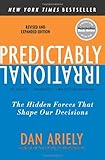
Predictably Irrational, by Dan Ariely

Predictably Irrational: The Hidden Forces That Shape Our Decisions, by Dan Ariely

I was the only one of my friends that didn’t like this book. It was fairly interesting in parts, but I found the conclusions very strange. Arbitrary coherence says that although initial prices can be “arbitrary,” once those prices are observed they will shape how future ones are perceived as well. An interesting premise, and coupled with plausible experiments Ariely paints a solid picture of the concept. From this, though, he decides we can’t trust the market forces of supply and demand to set prices and we should instead depend on “a reasonable and thoughtful government” to regulate markets. Any discussion where it is argued that government should take a larger role I believe to have a heavy burden of proof, and this didn’t come close. Other chapters explore similar forces that influence behavior such as emotion, morals, and social norms but because of the whopping problem I had early on I had a hard time taking the rest seriously.

The writing was engaging and pleasant, even funny at times. One passage in particular made me laugh quite a bit: “How did he persuade the cream of society to become passionate about Tahitian black pearls—and pay him royally for them? In order to answer this question, I need to explain something about baby geese.” This reminded me strongly of an old Bill Cosby album I used to listen to with my dad, Revenge. There was a track named “Buck, Buck” that was one of my favorites. It told the story of a teen named Fat Albert (yeah, that Fat Albert) that was darn funny; after almost five minutes he reaches what seems to be the final punchline, pauses, and then says, “I told you that story to tell you this one” and immediately launches into another story. That struck me as amazingly hilarious as a kid and it has stayed with me to this day. Anytime I encounter similar phrasing (such as the line about pearls and geese) I always hear “Hey Hey Hey” in that unmistakable Cosby voice and grin. While this anecdote has nothing to do with the content of the book, it sure took me back and made me smile.

First Sentence:
One day while browsing the World Wide Web (obviously for work—not just wasting time), I stumbled on the following ad, on the Web site of a magazine, the Economist.

Saturday, February 09, 2008

Other reading!

I was asked the other day why I haven’t been blogging much lately. I am still reading, but have simply been slow to post. A big reason, though, is that we’ve had a recent flurry of magazines start to hit the house. After Thanksgiving my wife and I had a bunch of airline miles that were about to expire so we used them to get a few magazine subscriptions. A week or so later, we received a letter saying that one of the publications we’d ordered was no longer available, and would we please pick five other titles for the inconvenience! A week after that we had another message arrive saying that one magazine was going to be delayed in starting and to pick yet another bunch as an apology. Needless to say that we now have piles of periodicals around the house, especially as we were already subscribed to three papers and a handful of other magazines already!

A quick pass of the house reveals the following recent arrivals:

The saddest thing is, I’m not sure I got them all!

Saturday, November 17, 2007

Permission Marketing, by Seth Godin

Permission Marketing: Turning Strangers Into Friends And Friends Into Customers, by Seth Godin

The basic premise of this book is that as Americans become increasingly inured to advertising, companies are going to be forced to changed their marketing tactics to get our attention. Godin calls the techniques that are commonly used today (telemarketing, commercials, ...) Interruption Marketing and holds that it is ineffective. Permission Marketing is the answer: offering incentives to get customers to voluntarily accept advertising. Not being a huge fan of advertising myself, I found the idea on its face to be nonintuitive. Godin does a good job of explaining the benefits, though, and by the end I was persuaded to his view of the world.

As with most business books today, this one is filled with illustrative examples. Most of these are used to great effect, such as Amazon.com tracking customer visits and purchases in order to provide ads and suggestions that are targeted at the individual and thus more likely to result in additional sales. Some of the examples, though, are dated enough to jar the reader out of the flow. It has been a long time since Alta Vista was the most visited search engine on the Internet, and a personal services company named Streamline is touted as being on the verge of huge success due to its marketing strategy although they shut their doors about a year after the book was published. Not hugely distracting, but it did clearly illustrate that the book is nearly a decade old.

First Sentence:
It’s not your fault.

Wednesday, April 06, 2005

The Tipping Point, by Malcom Gladwell

The Tipping Point, by Malcom Gladwell

While the rest of the country is reading Blink, I’m just getting around to Gladwell’s first best seller. After all the positive buzz, I was surprised this seemed so light in actual conclusions. The basic idea is that when a phenomenon reaches a certain critical mass (the “tipping point” of the title), it will grow exponentially. While an interesting thought, it isn’t supported by anything but a collection of anecdotes. I enjoyed reading it, but it took a long time to get through it because there wasn’t much substance.

First Sentence:
In the mid-1990s, the city of Baltimore was attacked by an epidemic of syphilis.

Search This Blog